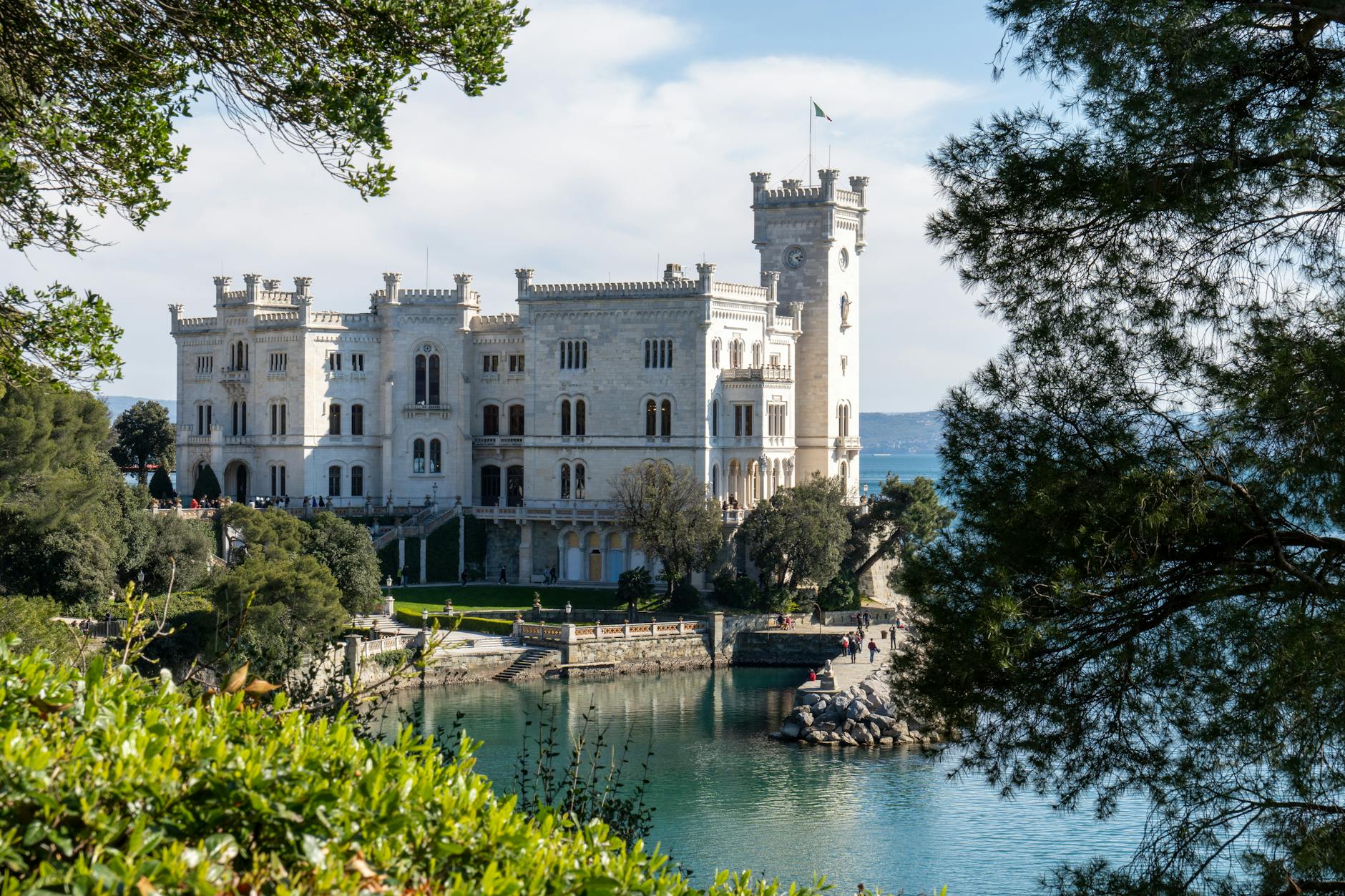
Trieste is a city that breathes history from every corner, with its cosmopolitan port and Austro-Hungarian heritage permeating its squares and literary cafés. Around it stretches the Carso, a wild and magnetic limestone plateau cut by underground rivers, vast caves, and small villages where time seems to have stopped. This is a territory for those who love discovering layers of civilisation, authentic flavours, and landscapes that tell stories of borders and encounters.
The Landscape
The Carso is a unique geological landscape: a limestone plateau extending between Trieste, Gorizia, and the Slovenian border, characterised by sinkholes, swallow holes, and spectacular caves like Grotta Gigante. Vegetation is sparse and adapted, with forests of black hornbeam and juniper. Trieste rises on a natural promontory overlooking the gulf, dominated by the medieval San Giusto castle. The territory is crossed by karst rivers, some underground, creating delicate and fascinating ecosystems. Villages like Monrupino, Duino, and Contovello preserve typical border architecture, with limestone houses and narrow streets. The Bora, the cold wind descending from the Balkans, shapes the region's climate and character.
History and Folklore
Trieste was a Roman port, medieval republic, and capital of the Austro-Hungarian Littoral until 1918. This cultural stratification is palpable in its streets. The Carso holds fascinating legends: the myth of the Bora as a spirit of the Balkans, stories of tobacco and wine smugglers along karst paths, traditions of shepherds who still transhumate on pastures. World War I profoundly marked the territory, with trenches and ossuaries remembering bloody battles. Karst villages maintain customs tied to primitive cheese-making and pastoralism. The feast of San Giusto (November) celebrates the patron and city's history, while local legends speak of a mermaid inhabiting the gulf and ghosts walking in caves.
What to Eat
Trieste's cuisine is a crossroads of Central European and Mediterranean flavours. San Daniele DOP prosciutto, Friuli's most celebrated ham, is venerated here; it's savoured in thin slices with fresh figs. Casunziei (ravioli filled with ricotta and spinach) and barley soup represent local comfort food. Montasio DOP, the region's distinctive cheese, matures in caves carved into the Carso. Unmissable is brodeto triestino, a dense fish soup rich in port stories. Carso veal, raised on pasture, offers tender and savoury meat. For sweets, putizza (brioche roll filled with walnuts and raisins) and Monrupino amaretti complete the authentic culinary experience.
What to Drink
Friuli-Venezia Giulia is a cradle of extraordinary wines. Vitovska DOC is the Carso's indigenous white, mineral and saline, perfect with Trieste seafood. Isonzo DOC includes Malvasia, Pinot Grigio, and Refosco, the latter robust and characteristic. Collio DOCG, from the Slovenian side, produces elegant whites like Tocai Friulano. Vitovska and Malvasia Istriana have roots in ancient Greco-Roman traditions. Carso's Terrano DOC is a Mediterranean red, tannic and profound. You cannot visit Trieste without tasting coffee at the historic Caffè San Marco, accompanied by natural Friuli wines as literary accompaniment.
When to Visit
Spring (April-May) is ideal: the Carso blooms, temperatures are mild, and Trieste's port bustles with life. Summer brings the Festival Mitteleuropa (July-August) celebrating music and literature. Autumn (September-October) offers clear skies and fewer crowds; best for karst hikes. November features the feast of San Giusto, the city's patron. Winter can be harsh due to the Bora, but Trieste fascinates with literary melancholy. The Truffle Festival (September, in karst villages) celebrates local black truffle. Avoid August if you dislike tourist crowds.
Places Worth Visiting
**San Giusto Castle**: perched on a hill in Trieste's heart, this 13th-century castle dominates the port and city. Its walls reveal incomparable views of the gulf; the interior museum tells Trieste's centuries. **Grotta Gigante**: a few km from Trieste, in the Carso, one of Italy's largest caves, with a 107-metre vault. The spectacle of light illuminating stalactites is unforgettable. **Duino**: tiny medieval village clinging to a cliff with its famous castle, inspiration for Rilke, and the scenic path toward the Falesia cliffs.
Practical tips
Rent a car to explore karst villages like Monrupino, Contovello, and Prepotto: hiking trails through sinkholes offer wild, authentic experiences.
Visit Trieste's historic cafés (San Marco, Tommaseo, Costalunga) where writers and thinkers have pondered the city; always order local coffee and a glass of Friuli wine.
Book a visit to Monrupino Wine Cellars to taste Vitovska and meet small family producers preserving karst winemaking traditions.
Plan your trip
Personalised day-by-day itinerary in 5 minutes — restaurants, hotels, live events.
Plan now