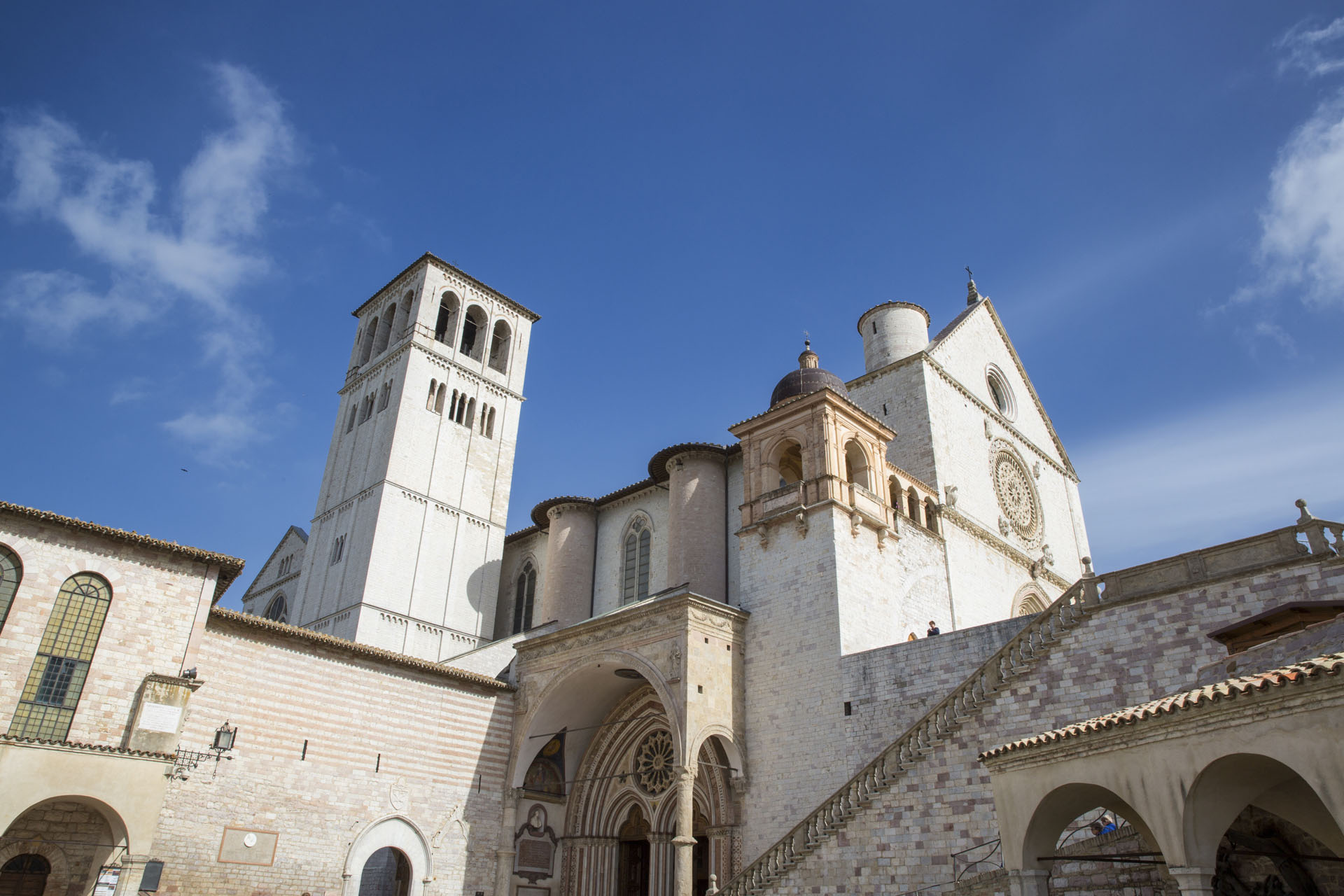
Assisi (UNESCO Heritage, 25,000 inhabitants) is reached from Perugia in 25 min by train (€3.30, Santa Maria degli Angeli station + 15 min bus to the centre) or from Rome in 3h by car (190km via A1 and E45). The Basilica of St Francis — built in two overlapping churches between 1228 and 1253 above the saint's tomb — is one of Christendom's most important religious sites and one of Italy's richest medieval artistic complexes: the frescoes of Cimabue, Simone Martini, Pietro Lorenzetti and Giotto make this basilica the place where Italian painting took the decisive step towards the Renaissance. Assisi's medieval historic centre dates to the 1st century BC — the Roman grid is still legible in the urban topography.
The Basilica of St Francis
The Basilica of St Francis consists of two overlapping churches: the Basilica Inferiore (the lower church, consecrated 1230, darker and more intimate) and the Basilica Superiore (the upper church, consecrated 1253, Gothic, luminous with large windows). Both are free. The Basilica Inferiore has: the Cappella di San Martino with Simone Martini's frescoes (1317, the most elegant narrative cycle of Italian Gothic), the Cappella di San Nicolò with Pietro Lorenzetti's cycle (1315-1320, the Last Supper with a view of Assisi through the window — Italian painting's first realistic urban view). The Basilica Superiore has the 28-scene cycle on the life of St Francis attributed to Giotto (1297-1300) — the cycle that marks the birth of modern narrative painting in Italy, with the rendering of space and emotions never previously achieved. The Crypt (below the Basilica Inferiore, €1, the urn with the saint's remains) is the heart of the pilgrimage.
The Historic Centre and the Eremo delle Carceri
Assisi's historic centre is among Umbria's best preserved — it dates to the 1st century BC and the Roman Forum (now below Piazza del Comune, €3 visit) is still visitable through the remains of the Temple of Minerva. Piazza del Comune has the Temple of Minerva (1st century BC, intact facade with six Corinthian columns — Umbria's most complete Roman remains, now a Christian church, free entry) and the Palazzo dei Priori (13th century). Rocca Maggiore (€5, the medieval fortress on the hill above Assisi) has the best view over the Umbrian Valley and the Umbro-Marche Apennines. The Eremo delle Carceri (4km from Assisi, 1h 30' on foot or by car, free entry) is St Francis's retreat in the Monte Subasio woods — the site's most austere and mystical place, with cells carved into the rock where the saint prayed.
Practical tips
The Basilica of St Francis is free — but silence is required in both churches, especially during celebrations
Giotto's cycle in the Basilica Superiore is read from right to left — start from the right wall at the entrance
The Eremo delle Carceri (4km, free) is Assisi's most authentic place — almost always empty compared to the Basilica
Assisi in August is crowded — May and October are the best times, with fewer pilgrims and ideal climate
Plan your Assisi day trip
Basilica of St Francis, Giotto and Eremo — itinerary in 5 minutes.
Plan now