Sicily and Sardinia are not merely provinces surrounded by saltwater — they are distinct insular worlds, continents in miniature. Sicily is an intense, volatile cultural crossroads, a prize fought over and deeply marked by every major seafaring empire in Mediterranean history: Greeks, Romans, Byzantines, Arabs, Normans, Hohenstaufens, Aragonese. Sardinia is an ancient granitic fortress of isolation, a territory whose geological age predates the rest of Italy, guarding prehistoric secrets that were already ancient when Rome was nothing more than a cluster of mud huts. To travel through these islands is to explore two entirely different ways the Mediterranean handles time: through the breathless, chaotic accumulation of foreign cultures, and through the proud, unyielding preservation of indigenous antiquity.

Sicily — The Polyphonic Crucible
Sicily is an island forged by fire and conquest. Dominated by the volatile, snow-capped silhouette of Mount Etna — Europe's largest and most active stratovolcano at 3,357 m — this triangle of land (Trinacria) sits at the literal centre of the Mediterranean. Because of this strategic positioning, it became the ultimate geopolitical prize over twenty-seven centuries of continuous habitation. Greeks, Romans, Byzantines, Arabs, Normans, Hohenstaufens, and Aragonese all ruled here, breeding their cultures together to produce a brilliant, polyphonic civilisation found nowhere else on earth. The result is an island where a single block can contain a Norman church built over an Arab mosque built over a Greek temple, where the cuisine mixes North African spices with Spanish techniques and Italian raw materials, and where five languages left their traces on a single dialect. Sicily is not complicated — it is layered.

Palermo, Monreale and Arab-Norman Sicily
The journey begins in Palermo, a city of intense sensory contrasts where Baroque palaces wrap around chaotic street markets — the Ballarò and Il Capo — that feel closer to a Middle Eastern souk than a European market. Palermo's unique golden age came in the 11th and 12th centuries under the Norman kings, who deliberately employed Arab architects and Byzantine craftsmen to construct their monuments, creating the world's only Arab-Norman architectural style, inscribed on the UNESCO World Heritage List in 2015. The ultimate expression is the Palazzo dei Normanni and its Cappella Palatina: pointed Saracen arches and an intricate Islamic wooden muqarnas stalactite ceiling hang over walls entirely covered in brilliant gold Byzantine mosaics. This is not syncretism as compromise but as ambition — a deliberate attempt to build the most beautiful room in the world by combining the three greatest architectural traditions then alive. Just outside the city on the slopes of Monte Caputo, the Cathedral of Monreale contains over 6,340 square metres of gold glass-tile mosaics, dominated by a colossal Christ Pantokrator in the apse. Entry to both: Cappella Palatina €12 (closed Sunday mornings); Monreale Duomo €4, cloisters €6. → See our Palermo 3-day guide for markets, street food, and the full Arab-Norman circuit.

The Valley of the Temples and Magna Graecia
On the southern coast, the island's ancient Greek identity comes forward at Agrigento, home to the Valley of the Temples (Valle dei Templi, UNESCO 1997). This is not actually a valley but a dramatic rocky ridge overlooking the sea, lined with a spectacular sequence of ancient Greek Doric temples built from local golden-hued calcarenite limestone. The crown jewel is the Temple of Concord (Tempio della Concordia), built around 440–430 BC — one of the two best-preserved Greek temples in the world, its 34 columns still standing to full height. At night, when these temples are illuminated against the black Sicilian sky and the scent of wild almond blossoms fills the warm air, Agrigento feels like a portal to the height of Magna Graecia. The archaeological museum on site (Museo Archeologico Regionale, €10, combined with park entry €14) is essential context: here the reconstructed Telamon figure (a giant Atlas supporting the Temple of Olympian Zeus, the largest temple ever attempted in the Greek world) makes clear the scale of ambition that this remote colonial outpost once had. Agrigento town itself is an ugly modern city — sleep instead in the agricultural valley below the ridge for the morning and evening light on the temples. → See our Agrigento and Valley of the Temples guide for logistics, the best viewing times, and the Almond Blossom Festival.

Siracusa, Ortigia and the Val di Noto
On the eastern coast lies Siracusa (Syracuse), founded by Corinthian colonists in 734 BC and within two centuries the most powerful and populous city in the Greek world — at its peak in the 5th century BC it outshone Athens in wealth and military capacity. The emotional heart of the city is Ortigia, a small limestone island connected to the mainland by two short bridges, a labyrinth of white stone alleys that open onto the breathtaking Piazza del Duomo. The Cathedral of Siracusa is an architectural marvel of continuous recycling: a 5th-century BC Doric Temple of Athena whose massive fluted columns were enclosed by stone walls during the Byzantine era and fronted by a theatrical Sicilian Baroque facade in the 18th century. To walk its aisles is to touch columns that have supported the prayers of three different civilisations across 2,500 years. Inland from Siracusa, the Val di Noto was devastated by a cataclysmic earthquake in 1693; out of the rubble rose an extraordinary urban reconstruction in soft yellow local limestone, producing the Sicilian Baroque towns of Noto, Ragusa Ibla, and Modica (UNESCO 2002). Modica is also famous for its cold-pressed chocolate: produced according to a traditional method inherited from the Spanish via the Aztecs, it contains no added butter or cream, resulting in a granular, intensely flavoured bar that is completely unlike anything produced elsewhere in Italy. → See our Val di Noto guide for Noto, Ragusa Ibla, Modica, and the Sicilian Baroque circuit.

Mount Etna and Taormina
The eastern horizon of Sicily is permanently dictated by Mount Etna (Mongibello to locals), rising directly from the Ionian coast to 3,357 m. Etna is Europe's largest and most active volcano — and also one of its most productive agricultural zones. The lower slopes are a landscape of black basalt lava flows, ancient lava tube caves, and fertile vineyards producing extraordinary mineral-driven wines under the Etna DOC: Etna Rosso (Nerello Mascalese, often compared to Burgundy's Pinot Noir) and Etna Bianco (Carricante). Producers worth visiting: Benanti (the pioneer, since 1988), Cornelissen (natural wine, radical terroir), Passopisciaro. The summit craters are accessible by cable car from Rifugio Sapienza on the south slope (€32 return to 2,500 m; additional 4WD jeep + guide to 3,000 m, €65) — check eruption status on the INGV website before going. Perched on a rocky cliffside in the volcano's shadow, Taormina holds the Teatro Antico: originally carved into the limestone rock by the Greeks in the 3rd century BC, expanded by the Romans, its stone stage opens at the back to frame a direct view of the Ionian Sea and Etna's smoking summit simultaneously. There is no more theatrical natural backdrop for a performance space in the world. → See our Taormina and Etna weekend guide and our Etna and Catania guide for winery visits and crater routes.

Sardinia — The Granitic Prehistoric Island
If Sicily is a crowded crossroads of empires, Sardinia is an island of proud, ancient isolation. Located far out in the western Tyrrhenian Sea, Sardinia is geologically independent from the Italian mainland — its granite massifs are among the oldest exposed rock formations in Europe, predating the Alps by hundreds of millions of years. This is a rugged, primeval landscape of pink and grey granite, wild cork-oak forests, and a coastline of blinding white sand and emerald waters that rank among the clearest in the Mediterranean. For millennia, its mountainous interior protected a distinct indigenous culture that successfully resisted full Romanisation, preserving a language (Sardinian, Limba Sarda, classified as an independent Romance language), a pastoral code, and a prehistoric material culture entirely unique to the island. The Sardinians have the highest concentration of centenarians per capita of any European population — a fact the island's tourism board is slowly learning to exploit.
Su Nuraxi and the Nuragic Civilisation
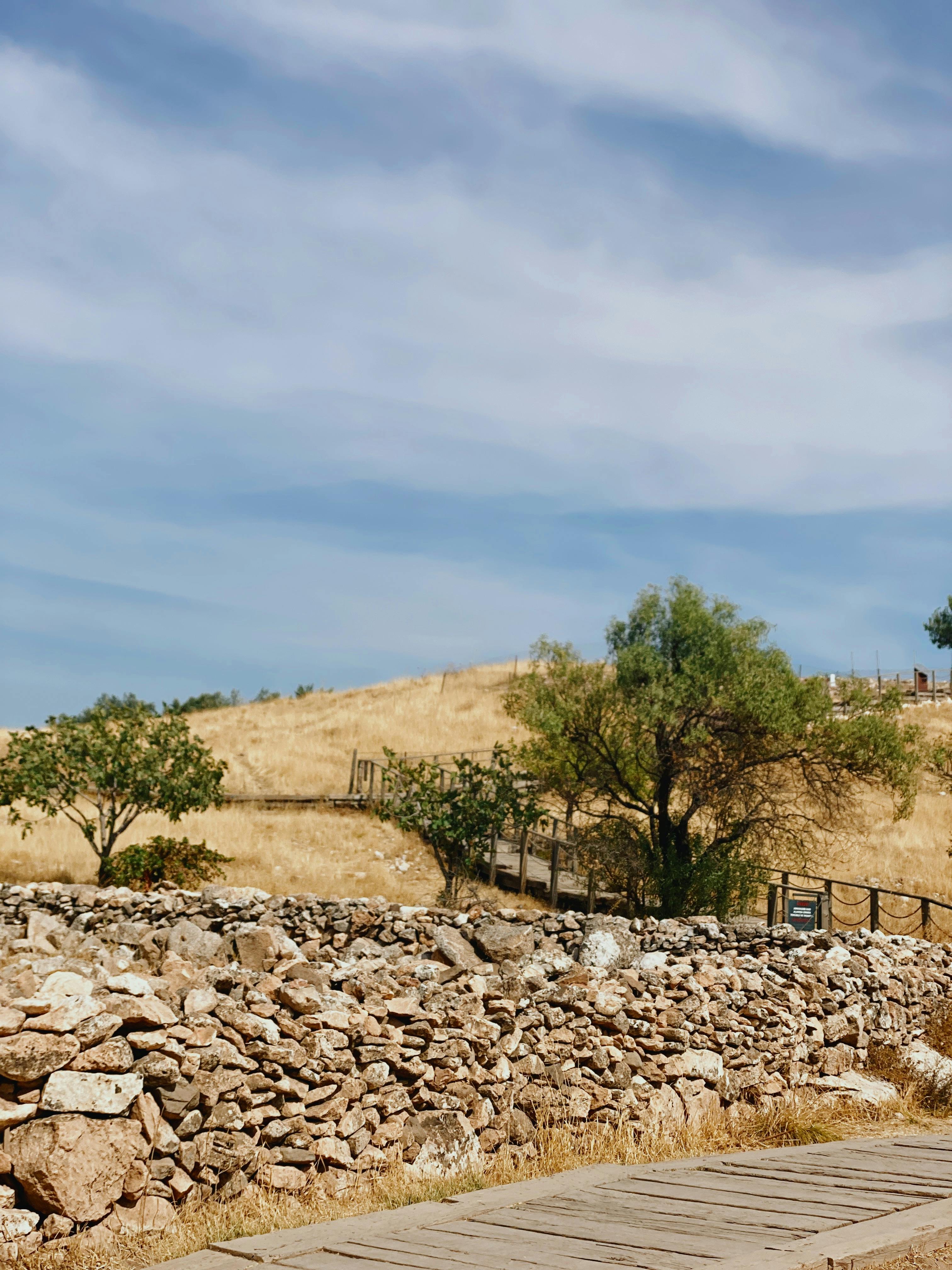
Long before the rise of any classical Mediterranean civilisation, Sardinia was home to the Nuragic civilisation (approximately 1800–700 BC). Its physical legacy is scattered across the island through over 7,000 nuraghi — immense megalithic stone towers and fortress complexes built entirely dry, without mortar, using massive basalt and granite boulders. The pinnacle of this engineering is Su Nuraxi di Barumini (UNESCO 1997), a massive complex in the rolling Marmilla plains. At its centre stands a multi-storey central tower originally rising over 18 m, surrounded by a defensive ring of four lateral towers connected by thick walls and a maze of over a hundred stone huts forming a prehistoric village. The Nuragic people left no written records; these cyclopean towers are the only testament to a highly advanced Bronze Age society that ruled Sardinia for over a thousand years before the Phoenicians arrived. Guided visits mandatory (€12, 45 minutes; book at the site ticket office, not online). The closest town with accommodation is Barumini village, 2 km away. Without a car, Su Nuraxi is extremely difficult to reach — the nearest train station is Sanluri, 25 km away, with no onward bus.

Barbagia, Orgosolo and the Wild Heartland
To find the unyielding soul of Sardinia, leave the coast and head into the central highlands of the Barbagia — a rugged mountainous territory beneath the limestone walls of the Supramonte and the peaks of the Gennargentu (1,834 m, highest point on the island). The Romans called this region Barbaria because its fiercely independent shepherd clans completely refused to submit to imperial control, retreating into deep canyons and dense forests to preserve their traditional way of life. That independence is still palpable. At the heart of the region lies Orgosolo, a steep mountain village famous across Italy for its murales — hundreds of large, politically charged paintings covering the rough stone facades of local houses. These murals began in 1969 as artistic protests against land expropriation and military occupation of the Pratobello plateau; today over 150 cover the village walls, depicting shepherd resistance, international political struggles, and everyday rural life. The Barbagia is also the birthplace of Cannonau wine — a high-antioxidant Grenache variant that grows at altitude on ancient ungrafted vines — and of pane carasau, a paper-thin crispy flatbread originally developed for shepherds away from home for months on seasonal migration (transumanza). → See our Barbagia guide for Orgosolo murals, the Supramonte trekking routes, and Cannonau cellar visits.

Costa Smeralda, La Maddalena and the Granite North
The northernmost tip of Sardinia presents a dramatic shift from the wild interior to an international paradise of water and stone. The Costa Smeralda (Emerald Coast), developed from 1962 by a consortium led by the Aga Khan IV, is a 55-km coastline of wind-sculpted pink granite boulders framing hidden coves of fine white sand and water of a shocking translucent emerald green. Porto Cervo is the operational centre — a purpose-built resort village with superyacht marina, luxury retail, and restaurants priced accordingly (dinner at a good restaurant: €80–130 per person). The Smeralda is not representative of Sardinia and was never meant to be: it is an international luxury enclave that happens to be in Sardinia. For granite coast without the price tag, drive 20 minutes east to the beaches of Palau and the Capo d'Orso bear rock. Floating just offshore is the La Maddalena Archipelago — a protected national marine park of over 60 granite islands and islets between Sardinia and Corsica. The main island, La Maddalena, is a historic naval base with pastel 18th-century houses; its wilder neighbour Caprera is the final home and burial place of Giuseppe Garibaldi (house museum €4). The archipelago is best explored by charter boat or organised day trip from Palau (€40–60 per person, including snorkelling stops at the clearest water on the Italian coast). → See our La Maddalena guide and our Costa Smeralda guide for boat hire, best beaches, and what the Smeralda is actually worth.
Practical tips
The Cappella Palatina in Palermo closes Sunday mornings — plan accordingly. Entry €12. The Duomo di Monreale (free interior, €4 cloisters) is best visited at 8am before tour groups arrive from Palermo.
The Valley of the Temples, Agrigento: visit at night when the temples are illuminated (until 11pm in summer, check seasonal hours). The combined park and museum ticket (€14) is valid two days — use day one for the eastern ridge temples, day two for the museum and western ruins.
Etna crater visits: check the INGV website (ingv.it) for eruption status before booking. The Silvestri craters on the south slope (accessible free, 1,900 m) are always open; summit excursions depend on volcanic activity. Book directly with guide companies at Rifugio Sapienza rather than through hotel desks — 30% cheaper.
Modena's ancient cold-pressed chocolate: buy from Sabadì or Bonajuto in Modica town (the original producer, founded 1880). The chocolate is unstable above 20°C — carry in an insulated bag, not in luggage in a hot car.
Su Nuraxi di Barumini: guided visits only, mandatory (€12, 45 minutes). No advance online booking — buy at the ticket office. Arrive by 9am in summer to avoid queues and midday heat on the exposed site. The archaeological museum in the village of Barumini (500 m away) provides essential context — visit it before the nuraghe.
Costa Smeralda in July–August: accommodation at Porto Cervo costs €400–1,200/night for a decent hotel. Drive 20 minutes east to Palau or Santa Teresa Gallura for the same granite coast at one-quarter the price. The water quality is identical.
Ortigia, Siracusa: park on the mainland and walk across the bridge — parking inside Ortigia is €3–5/hour with no guarantee of a space. The Fonte Aretusa freshwater spring on the waterfront (free) is worth 15 minutes: a natural spring emerging at sea level, populated by papyrus plants and a colony of ducks — the one site in Siracusa unchanged since the ancient Greeks.
Frequently asked questions
How many days do you need in Sicily?
7 days is the minimum to see the main sites without rushing: Palermo and Monreale (2 days), Agrigento Valley of the Temples (1 day), Siracusa and Ortigia (1–2 days), Taormina and Etna (1–2 days). 10–14 days allows you to add the Val di Noto Baroque towns, the Aeolian Islands (2–3 nights minimum), or the western coast around Trapani and the salt flats. A week in Sicily is a compressed highlight reel; two weeks is the start of understanding the island.
Is Sicily expensive?
Sicily is one of the cheapest regions in Italy for food and accommodation. A good dinner at a local trattoria costs €20–35 per person including wine. A 3-star hotel in Palermo or Catania: €70–110 per night. Agrigento and Siracusa are slightly more expensive in peak season (July–August). The main costs are transport: renting a car is essential for the interior and the south coast (€40–70/day), and Etna excursions add €30–65 per person. Overall, a week in Sicily for two people on a mid-range budget: €1,200–1,600 excluding flights.
When is the best time to visit Sicily?
April–June and September–October are the best months. Temperatures are warm (20–28°C), the countryside is green or gold, crowds are manageable, and accommodation costs 30–40% less than in August. July–August is peak season: the coast is crowded, accommodation doubles in price, and the island bakes at 35–40°C. The Almond Blossom Festival at Agrigento (usually February) is spectacular; the medieval carnival of Acireale (near Catania, February–March) is one of Sicily's most vivid. Winter is excellent for archaeology — the Valley of the Temples and Siracusa are far more atmospheric without summer tourists.
Do you need a car in Sicily?
Yes, for almost everything outside the main cities. Train connections exist between Palermo, Catania, Messina, and Siracusa, but are slow (Palermo–Agrigento is 2h 15′ by train, 1h 30′ by car). The Val di Noto towns, the Etna wineries, the western coast, and most rural accommodation are unreachable by public transport. Rent a car in Palermo or Catania from day 3 or 4 (once you have finished with the city), and return it at the end of the trip. ZTL zones exist in Palermo, Taormina, Noto, and Ragusa — check before driving into the historic centre.
How do you get to Sardinia?
By air or by ferry. Sardinia has three airports: Cagliari (south), Olbia (north, closest to Costa Smeralda), and Alghero (north-west). Direct flights from major Italian and European cities year-round; in summer Ryanair, easyJet, and Wizz Air add many seasonal routes. By ferry: Genova–Olbia (11 hours, overnight, from €40 per person foot passenger; car from €80–120); Civitavecchia–Cagliari (14 hours, overnight; €40–80 per person); Livorno–Olbia (7 hours, day or overnight). Grandi Navi Veloci, Tirrenia, and Moby Lines are the main operators. The ferry is worth considering for the romance and cost, especially if you have a car.
Is Sicily or Sardinia better?
They are incomparable because they are entirely different. Sicily is about culture, history, and food: layered civilisations, extraordinary archaeology, street markets, and a complex, intense cuisine. Sardinia is about landscape, wilderness, and beaches: prehistoric enigmas, mountain interior with genuine pastoral culture, and some of the clearest water in the Mediterranean. If you want history and food, go to Sicily. If you want nature, trekking, and beaches, go to Sardinia. If you have two weeks, do both: fly into Palermo, fly out of Cagliari with a week on each island.
What are nuraghi and why do they matter?
Nuraghi are megalithic stone towers built by the Nuragic civilisation of Sardinia between approximately 1800 and 700 BC — dry-stone construction using massive basalt and granite boulders, without mortar, some rising to 18 m or more. Over 7,000 survive across the island, making Sardinia the most dense concentration of prehistoric monuments in the Mediterranean. They matter because the Nuragic people left no written records; these towers are the only evidence of a highly organised Bronze Age society that ruled Sardinia for over a thousand years before Phoenician contact. Su Nuraxi di Barumini (UNESCO 1997) is the best preserved and most impressive.
Can you do Sicily and Sardinia in one trip?
Yes, but only with two weeks minimum and careful routing. There are no direct ferry connections between Sicily and Sardinia — you must fly (Palermo–Cagliari or Catania–Cagliari, 1 hour, frequent year-round) or return to the mainland. The logical routing: fly into Palermo → week in Sicily → fly Palermo or Catania to Cagliari → week in Sardinia → fly home from Cagliari, Olbia, or Alghero. Do not try to do both islands in 7–10 days — you will feel rushed in both.
What is Sicilian Baroque and where is it?
Sicilian Baroque is an architectural style that emerged after the catastrophic earthquake of 1693, which destroyed most of south-eastern Sicily. Towns including Noto, Ragusa Ibla, Modica, Scicli, and Caltagirone were rebuilt from scratch in soft local golden limestone, producing a distinctive style characterised by curving undulating facades, grotesque stone masks supporting wrought-iron balconies, and theatrical external staircases. Eight of these towns form the Val di Noto UNESCO site (2002). Noto is the most complete and photogenic; Ragusa Ibla is the most dramatic in its setting above a deep gorge; Modica is best for food (ancient Aztec-derived cold-pressed chocolate).
What is the best area to stay in Sicily?
It depends on the itinerary. Palermo for the first nights (Arab-Norman circuit, street food, markets); Agrigento or the valley below the temples if self-driving south (the town is ugly but proximity to the temples at dawn is worth it); Siracusa or Ortigia for the eastern coast (Ortigia is the most beautiful place to sleep in Sicily); Taormina for Etna access and the Greek theatre (expensive in August). For a road trip, moving accommodation nightly is the right approach — Sicily rewards mobility. A masseria (fortified farmhouse) inland from Noto or above Ragusa is the single best accommodation type on the island.
What Sardinian food should you try?
Pane carasau (paper-thin flatbread), malloreddus (small ridged gnocchi with sausage ragù, also called gnocchetti sardi), culurgiones (stuffed pasta from Ogliastra with potato, cheese, and mint filling sealed with a wheat-ear pleat), porceddu (whole roasted suckling pig cooked over myrtle wood, the island's defining celebration dish), bottarga di muggine (cured grey mullet roe, shaved over pasta or eaten alone with olive oil — Sardinia's truffle). To drink: Cannonau (Grenache), Vermentino di Gallura DOCG (the best white), and Mirto (myrtle liqueur, drunk cold as digestivo). The best food is found in agriturismo in the Barbagia interior and in the fishing restaurants of Alghero and Carloforte.
Is the Arab-Norman style unique to Sicily?
Yes. The Arab-Norman architectural style exists only in Sicily and only in buildings commissioned by the Norman kings between approximately 1072 and 1194. It is a deliberate fusion of three traditions: Islamic architecture (muqarnas ceilings, pointed arches, geometric ornamentation), Byzantine art (gold glass mosaics, Christ Pantokrator iconography), and Norman Romanesque structural forms. It was not a coincidence or an accident of borrowing — it was a deliberate political and aesthetic choice by kings who wanted to demonstrate cosmopolitan authority over a multi-religious, multi-ethnic population. Nine monuments in Palermo and Cefalù were inscribed on the UNESCO World Heritage List in 2015.
Plan your Sicilian or Sardinian trip
Day-by-day personalised itinerary — archaeology, beaches, and food in one arc
Plan now