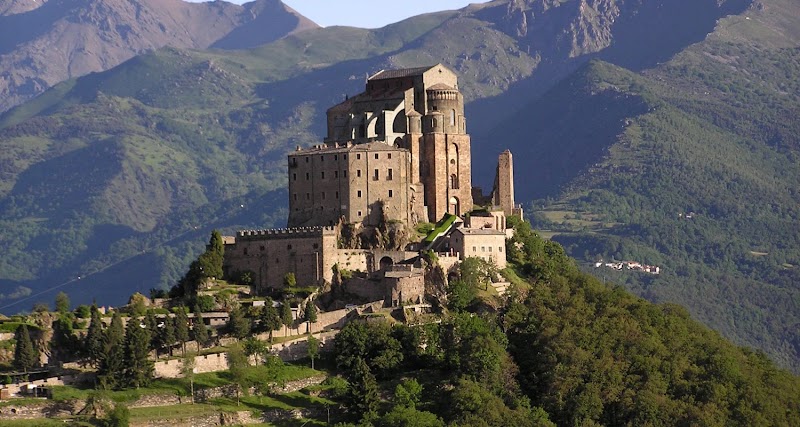
The Sacra di San Michele is Piedmont's symbolic building — the Region chose it as its official emblem. Built between 983 and 987 on a 962-metre peak at the confluence of the Susa Valley with the Po plain, it was inhabited by Benedictine monks for centuries before secularisation in 1622. Umberto Eco visited before writing The Name of the Rose: the novel's abbey draws from its structure, isolation and atmosphere. Today it is run by a small community of Rosminian fathers. The visit is one of Piedmont's most extraordinary experiences — not for any single architectural element but for the total effect of a medieval construction that emerges from living rock above the plain.
Getting There and What to Expect
The Sacra is at Sant'Ambrogio di Torino (TO), 35km west of Turin on the A32 motorway (Fréjus direction). By car: exit Sant'Ambrogio, follow signs to the Sacra — free parking at the base, then 45-60 minutes on foot uphill (350 metres elevation gain). From May to October a shuttle runs from the car park. By train + on foot: train from Turin Porta Nuova to Sant'Ambrogio di Torino (30 minutes, €3.40) then 1h 30 on the path. Opening hours: October-February 9:30am-5pm (6pm Sunday); March-June and September 9:30am-6pm; July-August 9:30am-7pm. Closed Monday (open on public holidays). Ticket: €7 adults, €5 reduced. Walk up from the car park — it is part of the experience.
The Visit: Staircase of the Dead and Church
Entry is through the Torre della Bell'Alda (12th century), then up the Staircase of the Dead — 150 steps cut into living rock, flanked by niches where the bodies of deceased monks were displayed. The name is not metaphorical. At the top, the Portal of the Zodiac (1120-1130): sculpted archivolts with zodiac signs, months, constellations and monstrous figures to keep evil spirits away — one of the finest examples of Lombard Romanesque sculpture. The church (11th-13th century) is built on bare rock: the presbytery is supported by pillars resting directly on the peak's summit. 16th-century frescoes in the choir are attributed to the school of Defendente Ferrari. From the outer terrace: 360° view over the Po plain, the Alps, and on clear days as far as Monte Viso.
Historical Context and The Name of the Rose
The Sacra was founded around 983 by Giovanni Vincenzo, a hermit who settled on Monte Pirchiriano. The current structure is the result of expansions from 1000 to 1300. In the 12th century it was one of Europe's most powerful religious centres on the Via Francigena — the pilgrim route to Rome — with up to 150 monks and dependencies across Europe. Decline began in the 14th century; it was suppressed by Pope Gregory XV in 1622 and secularised. Umberto Eco, interviewed multiple times on the subject, confirmed that his visit to the Sacra was one of the inspirations for the abbey in The Name of the Rose (1980). The burning library, the labyrinthine corridors, the sense of isolation on a rock — it was all already there.
Combining with the Susa Valley
The Susa Valley deserves more than one stop. 15km from the Sacra toward the west: Susa, a Roman town with the Arch of Augustus (9 BC), amphitheatre, baths and the Museo Diocesano d'Arte Sacra. 30km: Avigliana, with its medieval castle and the two natural lakes Grandi and Piccolo (protected area, excellent walks and cycling along the shores). Novalesa (50km, near Susa): Benedictine abbey founded 726 AD, one of Italy's oldest still active, with four external chapels and partially preserved 9th-century frescoes. Ideal full-day combination: morning departure from Turin, Sacra di San Michele (3-4 hours), lunch at Sant'Ambrogio or Avigliana, afternoon at Avigliana lakes, return to Turin in the evening.
Practical tips
Walk up from the car park (45-60 min) — it is part of the experience. The shuttle skips the perspective that builds on the ascent
Arrive by 10:30am to visit without groups — coaches arrive after 11am and the corridors become crowded
Bring layers even in summer — the altitude (962m) and wind from the plain make the terrace colder than expected
Eco's The Name of the Rose is set in an abbey inspired by the Sacra — reading (or rewatching) the novel before visiting makes the experience much richer
Plan your trip
Personalised day-by-day itinerary in 5 minutes — restaurants, hotels, live events.
Plan now