Ravenna has 8 UNESCO Heritage monuments — Italy's highest concentration per km², surpassing even Rome and Florence proportionally. Capital of the Western Roman Empire (402-476 AD) and then the Byzantine Exarchate (540-751 AD), it has preserved the world's most precious late-antique and medieval mosaics — produced over three centuries by Eastern craftsmen brought from Constantinople. The dating is crucial: these mosaics predate the European Middle Ages, they are the hinge between the classical and Christian worlds. From Bologna by train: 1h 05' (€8.50). From Venice: 2h (€15). From Florence: 2h 20' (€14).
The UNESCO Route: the 5 Main Sites
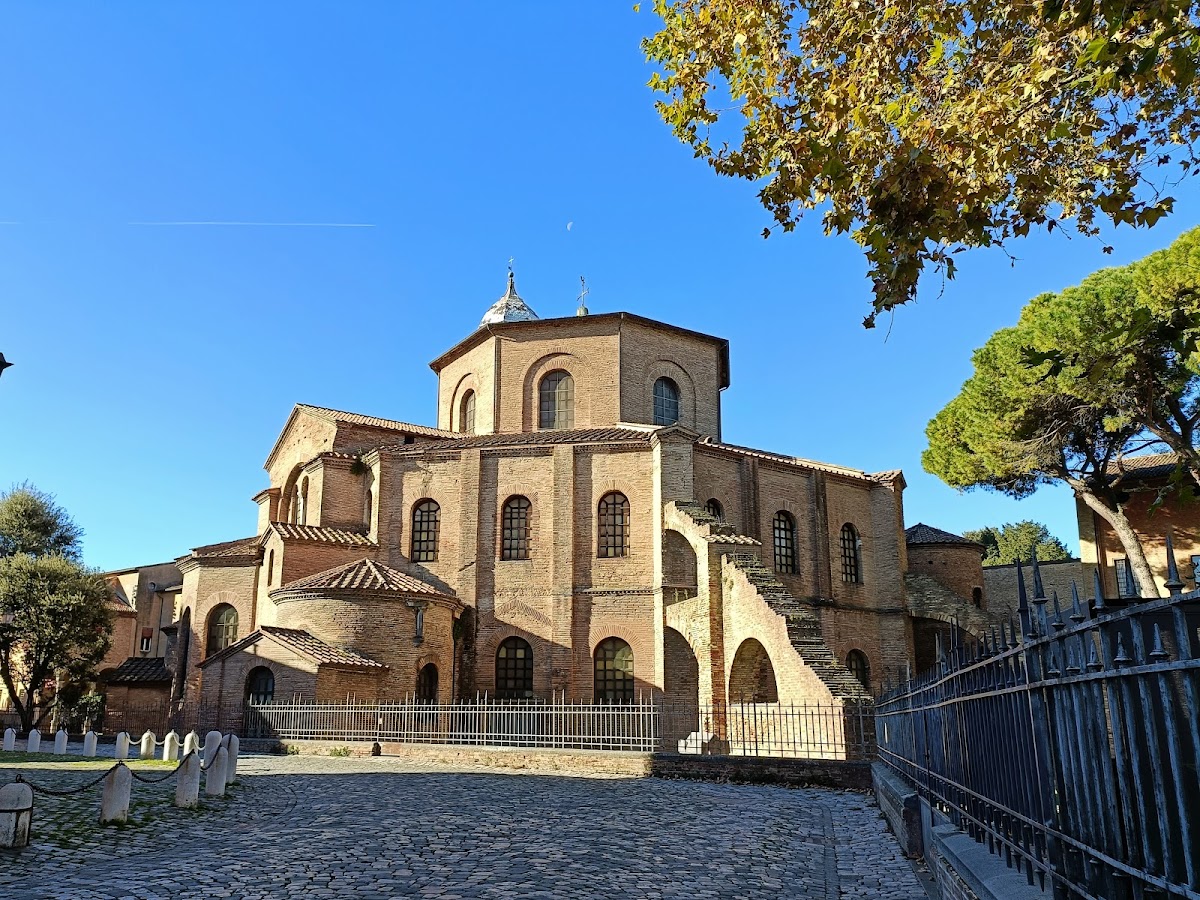
The cumulative ticket (€12.50, valid 7 days) includes the 5 main sites: the Basilica di San Vitale (547 AD, octagonal, the mosaics of Justinian and Theodora in the apsidal zone — the absolute peak of late-antique mosaic art, shadowless figures, golden haloes, wide-open eyes in a style that is neither yet medieval nor Roman anymore), the Mausoleo di Galla Placidia (5th century, the oldest site, 4 million navy blue glass tesserae on a starry sky — the most intense blue mosaic art has ever produced), the Basilica di Sant'Apollinare Nuovo (6th century, the procession of 26 male martyrs and 22 female virgins in two parallel rows on the nave sides), the Battistero Neoniano (5th century, octagonal, dome with the Baptism of Christ and 12 apostles), the Battistero degli Ariani (6th century). The Archbishop's Museum (€3 extra, included in other passes) has the Cappella di Sant'Andrea (5th century) with vestibule mosaics.
Sant'Apollinare in Classe and Dante's Tomb
The Basilica di Sant'Apollinare in Classe (5km outside Ravenna, bus line 4 from Piazza Farini €1.50 or taxi €12, €3 entry) is the oldest early Christian basilica in the site — built in 534-549 AD on the ancient port of Classe (the Western Roman Empire's military harbour). The apse has the mosaic of Sant'Apollinare among twelve sheep symbolising the 12 apostles, against a green landscape background with rocks and birds — one of late antique art's most serene landscapes. The church is almost always empty. Dante's Tomb (Via Dante Alighieri, free entry) is a small neoclassical tempietto of 1780 — the poet died in Ravenna in 1321 exiled from Florence, and Florence has always unsuccessfully asked for the return of his remains. The National Museum of Ravenna (€4, former Benedictine convent, near San Vitale) has northern Italy's most important collection of Byzantine ivories, bronzes and fabrics.
Practical tips
The cumulative ticket (€12.50) is valid 7 days — take your time with the mosaics, don't rush
Sant'Apollinare in Classe (5km outside the city) is almost always empty — the mosaics are beautiful and can be seen in peace
The blue of the Mausoleo di Galla Placidia is the most intense colour mosaic art has ever produced — enter with minimal external light
Ravenna pairs perfectly with Ferrara (40km, train) or Bologna (1h) — one day is not enough to appreciate it
Dante's Tomb is free and often overlooked — Florence has tried to return the poet's remains for 700 years without success