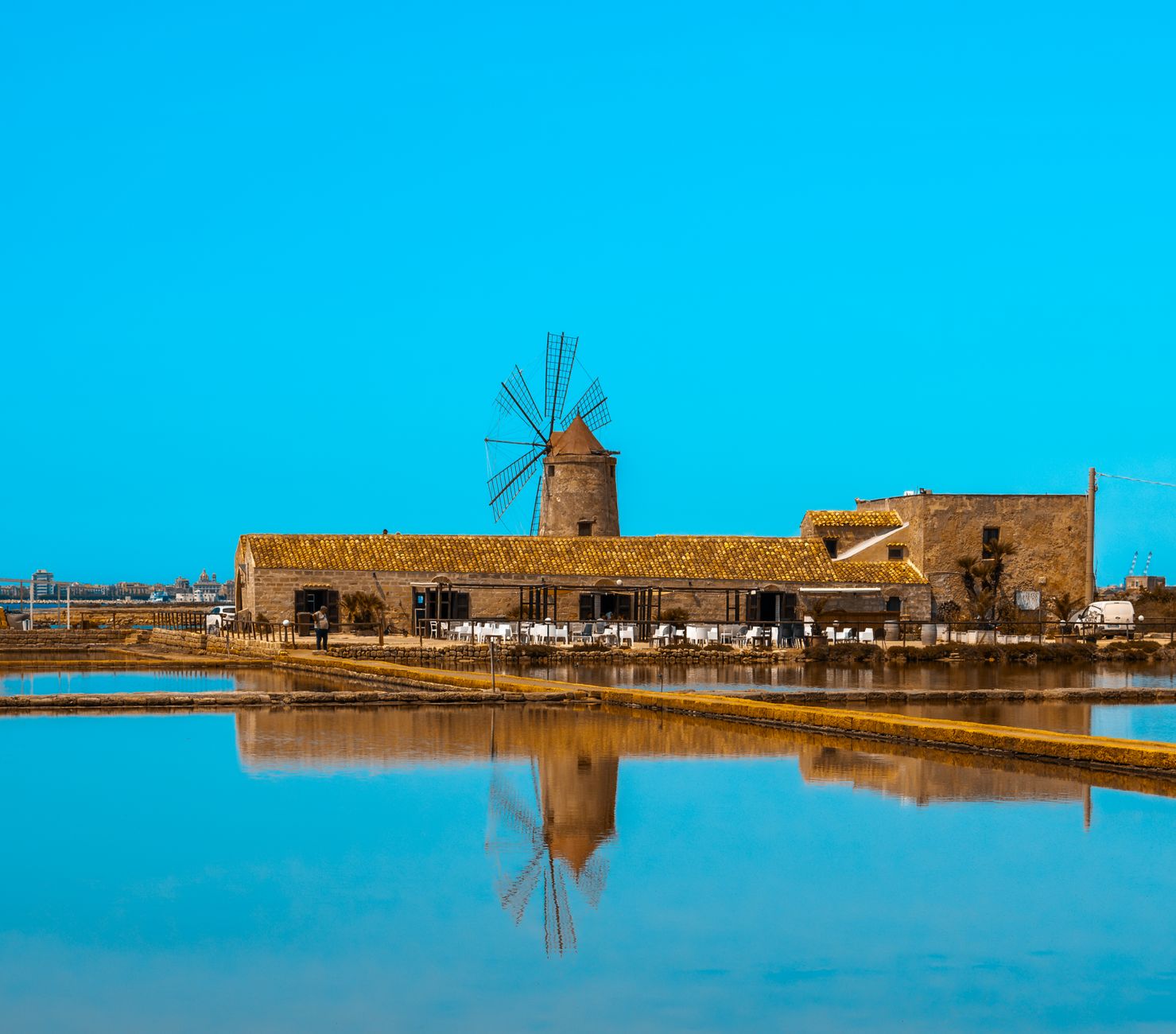
Trapani and its salt ponds represent the economic and spiritual heart of western Sicily, where white salt basins reflect like infinite mirrors under the sun. This unique landscape, shaped by centuries of human labour, tells stories of medieval trade, salt-worker families, and a culture inseparably linked to the Tyrrhenian Sea. Here, every sunset paints the waters in pink and gold, transforming hard work into poetry.
The Landscape
The Trapani salt ponds extend along the Tyrrhenian coast, a mosaic of rectangular basins separated by dykes where salt crystallises naturally. This UNESCO-listed landscape covers thousands of hectares between Trapani, Paceco, and Marsala. Lagoon waters mirror changing skies, while restored windmills—traditional trapeti—recall the productive past. Small hamlets like Nubia, San Cusumano, and Marausa gently climb the coast. Inland mountains create a theatrical backdrop, while the Stagnone Nature Reserve protects delicate ecosystems. The cretaceous limestone terrain, kissed by trade winds, is perfect for viticulture and salt agriculture.
History and Folklore
The Trapani salt ponds have roots in Phoenician and Arab times, when Normans recognised the strategic value of this production. In the Middle Ages, Trapani salt became a luxury commodity traded in Genoa and Venice's ports. Local legend tells of donna Francesca, a salt worker who lit fires on the mills during storms to guide fishermen home. Salt-worker families, called 'paludari', passed the trade down generations, developing a unique culture tied to seasonal rhythms and salinity. Sicilian folklore celebrates salt workers as custodians of ancestral wisdom, immortalised in folk ballads and celebrated during summer festivities.
What to Eat
In Trapani, the most representative dish is Pani e Panelle—fried pasta in chickpea pulp topped with crispy fritters, a street food telling centuries of Arab-Norman history. Trapani Arancini, pear-shaped and filled with ragù, are legendary. Don't miss Caponata Trapanese, vegetables sautéed in sweet-sour sauce, perfect with carasau bread. Swordfish alla Trapanese arrives from local markets with Mondello lemons. Fresh marinated anchovies are an essential starter. Caciocavallo Podolico DOP of Sicily, an ancient pulled cheese, accompanies traditional dinners. Finish with Almond Granita and warm brioche from historic pastry shops.
What to Drink
The Trapani region produces excellent wines. Ansonica di Contrada Bambina DOC captures the saline terroir's essence with mineral notes. Grillo DOC Trapani, a creamy white, perfectly accompanies fish dishes. For reds, Nero d'Avola DOC offers elegant freshness and subtle spice. Marsala Vergine DOC, produced in nearby Marsala estates, is a sublime aperitif and digestif. Also try Moscato di Pantelleria DOC, sweet and aromatic, from nearby island vineyards. Local producers like Cantine Florio and Baglio Hopps merit a visit for authentic tastings.
When to Visit
Spring (April–May) is ideal: mild temperatures, salt ponds in full production, and almond blossoms. In August, the Festa di San Giacomo celebrates Trapani's patron saint with crowded processions and fireworks. Summer (June–August) offers intense sun, perfect for watching salt crystallise, but is hot. In autumn (September–October), salt ponds assume golden hues while harvest animates surrounding vineyards. Winter is mild but less captivating for the ponds. Holy Week sees evocative processions in small coastal hamlets.
Places Worth Visiting
Museo delle Saline di Nubia: An intimate exhibition housed in a museum-home recounting salt workers' daily life with original tools and archive photographs. Riserva Naturale dello Stagnone: A protected lagoon where flamingos and herons nest, surrounded by the most scenic salt ponds. Walkable along dykes at sunset. Marsala Antica: The nearby wine hamlet preserves historic cellars like Florio's, where to taste celebrated Marsalas in authentic atmosphere among century-old vineyards.
Practical tips
Visit the salt ponds at dawn or dusk for the most spectacular reflections; salt workers begin work at sunrise.
Rent a bicycle to cycle the salt pond dykes: easy trails, infinite vistas, and encounters with local communities.
Taste pani e panelle from historic street vendors in the main square: authentic and just a few euros.
Plan your trip
Personalised day-by-day itinerary in 5 minutes — restaurants, hotels, live events.
Plan now